Sermon text: John 10:1-10
The grace of our Lord Jesus Christ, the love of God, the fellowship of the Holy Spirit be with you all. Amen.
When the Stanford kids were little sheep, they got used to hearing this: Reeves, River, Bliss, Brins, Bri, Clare, get home! Nice and loud throughout. No matter where they were in the neighborhood, it was heard, and they came. Today is the fourth Sunday in the season of Easter. And the fourth Sunday is also designated as Good Shepherd Sunday. Now, the passage most associated with Good Shepherd Sunday is one we like to hear, but not included in our gospel lesson this morning: “I am the good shepherd. The good shepherd lays down his life for his sheep.” But that verse is actually John 10:11. And our reading stops one verse prior to verse 11. The assigned reading for this Good Shepherd Sunday stops short. And so what we’re left with is a reading filled this morning with stuff about thieves and robbers breaking into a sheep pen, doorkeepers, killers, strangers, and general words of warning — all indicating that this is a dangerous world for little lambs and little sheep of the church of Christ.
On the other hand, when we hear talk about heaven, it’s contrasted with the evil of this world. We often get the image of a great city in clouds with pavement made of gold, and a city surrounded by a great wall. We follow that path, a path magnificently, beautifully wrought to the pearly gates. And there it is — it’s often said that St. Peter, who looks like a kindly old bald man with a great white beard, gentle eyes, wearing a white robe, greets you from a booth or a podium as he sits on the chair with a book of life before him. He makes sure that your name is in the book of life, and he has a pleasant voice, and he invites you in. But on Good Shepherd Sunday, we see something a little different in our text. The door to heaven isn’t a pearly gate. The scene is not fluffy and white. It’s bloody red. What’s more, you just don’t saunter up to the door for a casual Q&A session: let’s see how you did down there on good works. That’s how most people think it works. But it doesn’t. The door is either wide open for you or it’s closed tight. The voice is inviting you in or it isn’t. And the voice isn’t Peter’s. It’s much better than that. It’s the voice of Christ, the good shepherd himself. The voice of our shepherd calls us to follow him through the door, which is Jesus Christ himself on the cross. John records Jesus saying, “I am the door of the sheep.” We don’t think of the door of a sheep pen as the one and only entrance into the heavenly realm. But that’s the fact of the matter: that’s what it is. It’s true.
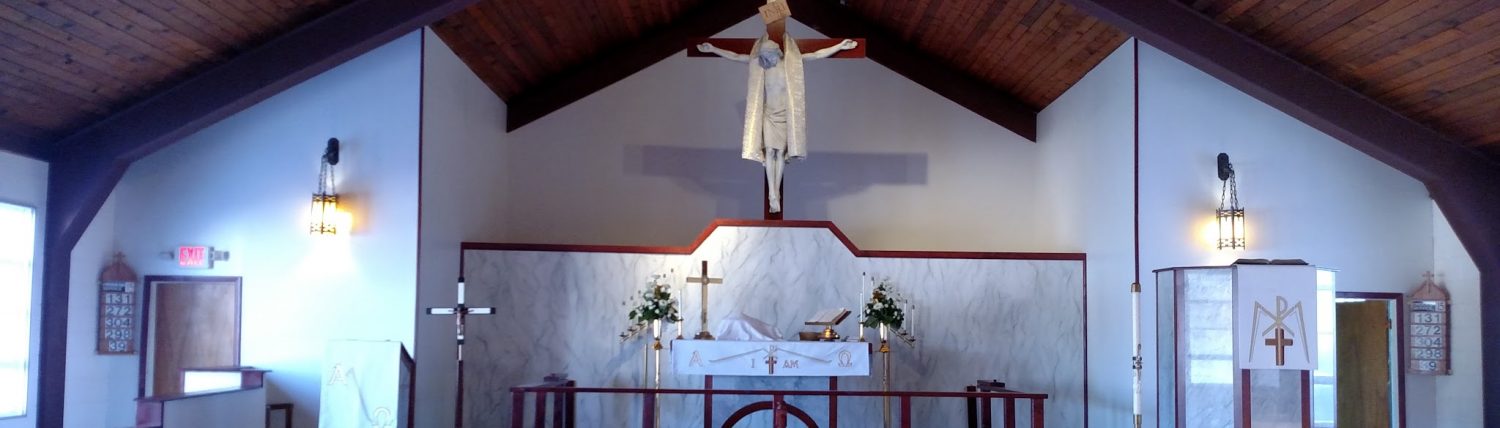
What did a door on a sheep pen look like in Jesus’s day? Well, there are probably variations, but most of them were made of wood: a solid piece or slats tied together. Wasn’t very attractive. Wasn’t very easy to function with. It was a door that dragged frequently on the ground. It may have been a solid piece. It may have been several pieces, but it was banded together. It had one purpose, and that is to keep the sheep in and the thieves and robbers out. For the purpose of today, I want you to think of that door as a cross, because it’s the only way through which — that is, Jesus’s cross — we are set free from sin, death, and the power of the devil and able to make it into eternal life. It is Jesus on the cross who is the door. Just as sin locked Adam and Eve out of paradise, sin would bar the door to heaven to us as well. But as the real St. Peter writes in our epistle reading this morning: he himself bore our sins in his body. By his wounds you have been healed. For you were straying like sheep, but now you have returned to the Shepherd and Overseer of your soul. “I am the door,” Jesus says. “If anyone enters by me, he will be saved and will go in and out and find pasture.” Our shepherd calls us to follow him through the cross. We just don’t go to the cross. We go through the cross. We’re joined to his death on the cross and to his resurrection to a new life. In our baptism, we are made to enter into his death, for he died with us. But his death becomes our death by virtue of our baptism. Romans 6:3-4: “Do you not know that all of us who have been baptized into Christ Jesus were baptized into his death? We were buried therefore with him by baptism into death, in order that, just as Christ was raised from the dead by the glory of the Father, we too might walk in newness of life.” And like our Savior, we do not stay dead, for we go through death into life. He rose; we will rise. We have been made alive with a new spirit, and on the last day we will physically rise in glory even as he rose on that first day of Easter. Our lives are a process of going through his death on the cross and finding forgiveness and safety in the sheep pen, which is the church, the kingdom of God on earth.
The trials, pains, and sufferings we experience in this life are part of going through Christ’s death. What is the source of our sickness that we face? What is the source of people being hostile to us? What is the source of being lonely and in want? All these kinds of things are the consequence of sin: either the general condition of it, or of specific particular sins that we commit in our life that make messes that we have to deal with. Yet the crucified Jesus is the door we pass through, leaving those troubles behind, because Jesus took all our sin to the cross and saves us on the last day from all the effects of sin. Our good shepherd leads us through this life to the life on the other side of the door. He is with us through each hardship we face in life. So as we face our struggles, we are joined more intimately to the one who has already gone before us and on behalf of us. It is a process of bringing his victory to bear in every moment and in every struggle of our lives. We become more and more his, for he becomes more and more the door for us.
People don’t like hearing that there’s only one door. People think they should be able to pick whatever door they want, that all doors lead to the same place. After all, the world would rather have us believe: what works for you spiritually might not work for me. Just having faith in something is important. As long as you think that it works for you, that we are good people, that’s enough to satisfy that old balding St. Peter. That’s the thought. But if the object of faith is not Jesus Christ and him crucified, then it is not true faith. It is not good. Regardless of how much you might want to put makeup on it and dress it up, a good work never saves except Christ’s. All of those other doors and shepherds are of the devil. Only one voice invites us through that one door. Jesus said, “He who enters by the door is the shepherd of the sheep. The sheep hear his voice, and he calls his own sheep by name and leads them out. When he has brought out all of his own, he goes before them, and the sheep follow him, and they know his voice.” And there’s lots of voices out there contending for the attention and affection and loyalty of the sheep. Sometimes they even sound like us. We are really good at talking ourselves into all kinds of trouble by listening to other people and what they think about this or that, or what cause we ought to sign up for. We can convince ourselves that there is something truly good for us when it is just the opposite. We convince ourselves that making sure the kids have a robust life and their favorite sport or social activity is worth the sacrifice of a robustly lived church life. We convince ourselves that our ideas about the Christian faith are in fact Christian when they are not. There’s a great multitude of voices calling out to us, all designed to lead us where we ought not go. There are voices clamoring for our attention in the world: it is a good cause you ought to invest in. We can save the world if we do this or that. God is love. So if you don’t support whatever I happen to love, you’re a hateful, despiteful person. The voice and the cry to save America, from both the progressives on the left and hard right conservatives, almost drowns out the voice of the good shepherd these days.
The fact is that we don’t like to be shepherded. We often fall prey to the wolves of our generation who preach and teach false philosophies and religions and misuse and twist the word of God in such a way that we hear what we want to hear. Thus the warning in 2 Timothy: “For the time is coming when people will not endure sound teaching, but having itching ears they will accumulate for themselves teachers to suit their own passions, and will turn away from listening to the truth and wander off into myths.” The unfortunate truth is that we have not fled the voices as we ought to. We’ve listened to them. We indulged them. We appease them. We’ve been lured into temptation and false promises of greener pastures. These voices steal our attention and our hearts away from our good shepherd. They offer doors to pass through to greener pastures, but these pastures are barren and offer no true food, and certainly not eternal life. All who go to them will starve to death, and often eat one another during the starvation.
Here in the gospel lesson this morning, at the beginning of Jesus’s Good Shepherd discourse, he begins by teaching us to listen to the right voice — his voice — and to close your ears to the thieves and robbers who seek to mislead you in so many ways. Instead, he calls upon us to listen carefully to your good shepherd as he speaks through his word and through his undershepherds of the true Christian faith. We are to measure all things in the church by the word of God. You must understand what the gospel is in its fullness. For in the gospel, all the other teachings of the Christian faith are contained. The law — that is, we’re taught by the law that we need a Savior. The doctrine of justification, the means of grace, holy baptism, holy communion, the doctrine of the church, the doctrine of election, the doctrine of sanctification, and more: all of these are bound up into one package called the gospel of Jesus Christ. You may know what you believe regarding each one of those doctrines, but do you know what the Bible actually teaches regarding all of those doctrines? This is why St. Paul wrote in Galatians 1:8: “But even if we or an angel from heaven should preach to you a gospel contrary to the one we preached to you, let him be accursed.” Again, I say: if we or an angel from heaven preach another gospel to you, let him be accursed. The apostles would not have your salvation stolen from you and replaced with a gospel that is really no gospel at all. The voice of our good shepherd calls us to repent. And repentance in this context is fleeing from those voices — the voices of strangers and false teachers, robbers and thieves — and hearkening to the voice of Christ alone, which is contained in his written word, the Bible, and contains all of the doctrines of the Christian faith.
There’s only one door. It’s Jesus Christ and him crucified. He calls to us and leads us through the door of his cross to true life, joy in life, and the life of the world to come. The blessings of the cross as the door: all of those other voices and all of our failings are silenced in death and placed in the tomb. All of those voices and all of those temptations and all of those sins to which we fall prey rot in the tomb, while we rise to a new life in Jesus Christ our Savior. There we find joy. There we find true love. There we find fulfillment in him and all that he gives, because the good shepherd laid down his life for the sheep. This he did for you. Jesus said, “I came that they may have life and have it abundantly.” And so you do, because your sins are forgiven and you’ve entered the sheep pen through the door. Amen.
May the peace of God, which passes all understanding, keep your hearts and minds in Christ Jesus. Amen.